
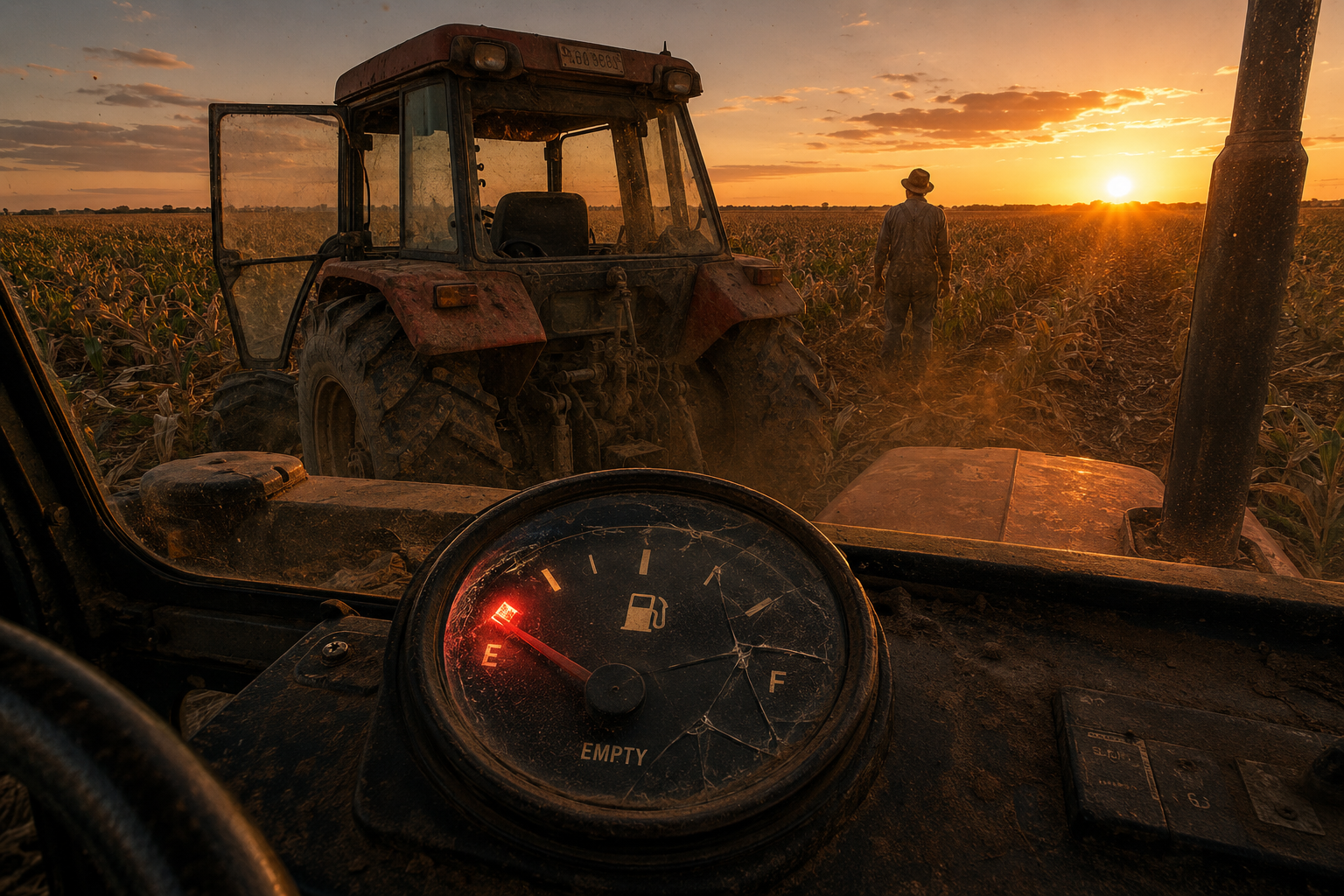
Every week, a new farmer commits capital, sometimes a lifetime’s savings to an agricultural venture armed with a budget that tells half the story. The spreadsheet looks convincing. The projected revenues are promising. And then, twelve to eighteen months in, the project begins to unravel, not because the farming is bad, but because the numbers were never real to begin with.
This is not an accident. It is a systemic problem baked into how agricultural budgets are produced and distributed in our industry.
The Document That Started the Problem
Walk into any input supplier, seed company, fertiliser distributor, or commodity marketing organisation and ask for a production budget. They will hand you one — often a professionally formatted document with per-hectare costings, yield projections, and indicative gross margins.
What you will notice, if you look carefully, is what is not in those numbers.
These budgets are produced by parties with a specific interest: to sell you their product. The fertiliser company is costing fertiliser. The seed house is costing seed. The irrigation equipment supplier may even throw in an infrastructure estimate — but only for their portion of the system. Nobody in that room is responsible for the totality of your farming enterprise, and so nobody accounts for it.
The result is a budget that is, at best, a partial commodity costings exercise. At worst, it is a document that creates dangerous false confidence in a project’s viability.
This is what a typical supplier budget looks like:

Look at what it covers: seed, fertiliser, chemicals, and a single revenue line. That is it. A farmer reading this document would be forgiven for believing they have a complete picture of their project. They do not.
What Is Missing — And Why It Matters
The gaps in that budget are not minor rounding errors. They are structurally significant costs that can represent 30 to 60 percent of true project expenditure. Yet they appear nowhere in the document a farmer is most likely to receive.
Infrastructure and startup capital is almost never costed in a supplier budget. Irrigation system design, installation, and commissioning. Fencing — perimeter, internal camps, and predator-proof where required. Access roads and water crossings. Labour accommodation, storage units. Reservoirs and boreholes. Electricity connection or off-grid power. These are not optional extras. They are the foundational capital without which the farm cannot function, and they can easily run to several million rand before a single crop is planted.
Distance and logistics costs are invisible in most budgets. A farm 180 kilometres from the nearest input depot, cold chain facility, or market does not operate on the same cost base as a farm 20 kilometres away. Transport costs for inputs, produce, and staff are real, recurring, and often substantial. Standard budgets assume a price at the farm gate or at the market, they rarely model the actual cost of getting there.
True labour costs are chronically undercosted. What is frequently captured is the hours worked for the primary production task. What is rarely captured: irrigation operation and maintenance staff, security and night watch, supervisory and management allocation, seasonal overtime, meals, PPE, accommodation allowances, and statutory contributions. A budget showing two permanent workers for a 10-hectare vegetable operation is not showing a realistic picture.
Working capital requirements are perhaps the most dangerous omission of all. A cash flow is not a budget, and a budget is not a cash flow. Many first-time commercial farmers are capitalised to get the crop in the ground. Very few are capitalised to carry the enterprise through the full production cycle — through the lean months, through the delay between harvest and payment, through the season that yields 60 percent of projection. Working capital is the buffer that separates a farming business from a farming crisis. It is almost never quantified upfront.
The Consequence: Projects That Run Out of Road
A project begins with enthusiasm and genuine capability. For the first few months, everything tracks. Then, quietly, the cash position tightens. The working capital meant to carry the enterprise through to harvest runs short — not because the farmer is reckless, but because the original budget never accounted for the full cost of getting there.
By mid-season, the farmer faces a choice no budget should ever force: fund the full top-dressing programme or keep the operation running. The fungicide schedule gets cut. The second fertiliser application is reduced. The decisions feel small in the moment. Their consequences are not.
The crop that comes off is not the crop that was planned. Yields are down. Quality is compromised.
What looked like a farming problem is, in fact, a financial planning problem that originated before the first seed went in the ground.
The tragedy is compounded by the fact that the farmer was often right about the farming. The agronomics were sound. The market opportunity was real. The enterprise failed not in the field, but in the budget.
What a Complete Budget Actually Looks Like
A budget built to serve the farmer — rather than to sell a product — has a fundamentally different architecture. At Simuka Agri, we build financial models that begin before the first production cycle and account for the full cost of bringing a farming enterprise to sustainable, bankable operation.
This is what a comprehensive financial analysis looks like:

The difference is immediate. Where the supplier budget covered three cost categories, the Simuka Agri model covers the full picture — from total capital requirement through to a sensitivity analysis that tests the enterprise against realistic adverse conditions.
Specifically, every Simuka Agri financial model includes:
Total capital requirement — all infrastructure, establishment, and equipment costs itemised and costed at current market rates, including actual quotes where required. The farmer knows the full capital ask before committing a single rand.
Phased infrastructure planning — not all capital is required on Day 1. We identify what is essential at establishment, what can be phased over Years 1 to 3, and what the cash flow implications are of each approach. This protects working capital without compromising the project.
Full-cost production budgets — every input and operational cost is included: direct production, transport and logistics, full labour complement with statutory costs, water and electricity, crop insurance, and farm management. Nothing is excluded because it is inconvenient or supplier-specific.
Realistic revenue modelling — revenue is modelled at three scenarios: conservative, base case, and optimistic. Price assumptions are grounded in historical market data and account for seasonality, quality differentials, and the actual distance to market. Yield assumptions reflect genuine first-year establishment performance — not the Year 3 optimum that many supplier budgets use as a baseline.
Working capital quantification — the working capital requirement is explicitly calculated: how much cash the enterprise needs to carry from one production cycle to the next, to service debt, to absorb a partial season, and to fund the ramp-up period before the enterprise reaches maturity.
Sensitivity analysis — the model is stress-tested against realistic adverse scenarios. Lower yields, lower prices, input cost inflation. If the enterprise cannot survive these conditions, the farmer needs to know before they invest — not after.
The Difference It Makes
The difference between a partial budget and a comprehensive one is not just financial rigour. It is the difference between a farmer who is surprised by costs and one who is prepared for them. It is the difference between a working capital facility that was planned for and one that is sought in desperation. It is the difference between a project that reaches its potential and one that is abandoned at the point where the original budget simply ran out.
Agricultural enterprises are long-horizon commitments. The decisions made at the planning stage — including the quality of the financial model — echo through the entire life of the farm. Getting this right at the beginning is not a luxury. It is the foundation on which everything else is built.
A Final Word to the Farmer
The farmers who build sustainable, bankable enterprises are not necessarily the best agronomists or the most connected marketers. They are the ones who went in with their eyes open — who knew exactly what the project would cost, what it would realistically earn, and how much runway they needed to get there.
That clarity is what Simuka Agri delivers.
Simuka Agri specialises in comprehensive agricultural financial planning — including full capital budgets, realistic revenue models, and working capital analysis — for farmers, investors, and financiers. Contact us to discuss your project.